We were invited to a winter talk with Perranporth Conservation Group at Seiners Arms, by two divers Chris Lewis and his wife Cathy, both members of Helford Conservation Group who capture what they see on the river bed including sharks and rays! We were really interested and we had no idea what was beneath us as we kayak along the Helford on our Helford Koru Kayak Adventures or Helford River Cruises.
The Helford is quite unique as it’s a Ria, a flooded valley, rather than a river. Thousands of years ago during the ice age sea levels rose creating flooded valleys like the Helford. It’s shallow beds are home to an abundance of wildlife including sharks and rays and these videos were shot at just 7 metres deep! It’s taken us back to our snorkels off Lady Elliot Island, South Barrier Reef in Australia where Blue Planet was filmed.

Thornback Rays on the Helford River, Cornwall, UK

Stringrays, Great Barrier Reef, Australia
We had no idea what was underneath us as we kayak along the Helford, but we were about to find out. The Maerl stretches from St Mawes in the shallows down past Castle Beach and into the Helford.
Here’s our guest blog from Chris Lewis, Diver from Helford Conservation Group
The Helford sits within the Fal and Helford Special Area of Conservation partly in recognition of the diversity of invertebrate life found within it and because it is a key nursery area for many marine species.
Diving generally takes place at around seven metres depth to the East of the Helford River moorings. This area includes two key habitats, seagrass and maerl (nodular pink calcified algae) as well as sand and mixed ground. Most of the video is from the Helford or the nearby Fal maerl beds, though a few clips are from further afield, but all the species and activities have been observed in the river. The material covers only a few of the many amazing sights available to those who can get beneath the waves.
Molluscs
Bi-valves:
In parts the bottom is covered with bi-valve shells, the living creatures themselves being buried beneath the seabed. However both King and Queen Scallops can be seen in the open or part buried. They have simple eyes, up to two hundred in the Queenies, so can spot predators such as starfish approaching and can jet propel themselves to safety by clapping their shells together to expel water.
Sea Hares:
These sea slugs are simultaneous hermaphrodites. When mating as a pair can act as either male or female, but in larger groups can act as both at the same time! Sometimes they will form a complete circle, known as a daisy-chain, when all of them are taking both roles.
Sea Snails:
The Large Necklace or Moon Shell is the most attractive looking of our sea snails but this hides this hides their true nature. They are driller killers using their rasping tongue to make a hole in a bi-valves shell into which they inject digestive enzymes which liquefy their prey.
The Whelk is our largest sea snail and trundles across the seabed like a tank. They use their syphon to detect chemical cues in the water to lead them to their prey. They also have a rasping tongue but can often be found using brute strength to open their bi-valve meals.
Netted Dog Whelk are probably the most successful scavengers in the Helford. They too can sense when a meal might be available and will quickly congregate around any part consumed bi-valves. After much pushing and shoving a lucky few will get to the left over flesh with disappointed late comers soon heading off to try their luck elsewhere.
Turban Top Shells show a surprising turn of speed. With otherworldly features they hoover algae and diatoms from the surface of the seabed or empty bi-valve shells. Like many snails they need the ability to self-right themselves to survive the rough and tumble of the seafloor.
Small Benthic Fish (fish that live on the seabed)
Painted Gobies:
Pinky finger sized, these fish are real characters and very common in the Helford. The males make use of a single bivalve shell as a roof to their nest. They will display their finnage and shout (like a fast drum roll) to entice females to the nest to lay their eggs for them to fertilise and guard. They also use their displays and vocals when competing with other males. The louder male will often win a contest without the need for violence, but if this show of strength fails then males will attack one another. Successfully holding a nest and raising offspring is a tough undertaking and they put everything into it.
Keeping energy levels up requires they spend much of their time looking for food. A sizeable polychaete worm found in the maerl bed is quite a prize. Everyone will want a piece so competition is fierce.
Dragonets:
Like many bottom living fish Dragonets can alter their colour to better match the substrate they are on. These Common Dragonets have taken on their red colouration as they live within a maerl bed. They are feeding on tiny invertebrates which involves taking a mouthful of sand and mud, ingesting the edible morsels, then spitting out any sand particles. Lastly they expel the finer mud elements forcefully out of their spiracles, as if making smoke signals. By their own feeding, Spider Crabs expose the mud beneath the maerl layer. If a crab moults or dies then the nutrients released will attract more invertebrates and more Dragonets will join the smoking party.
Reticulated Dragonets have been described as the most beautiful fish in our seas. But this can only be applied to the males, who, like a Peacock, show off their stunning colouration when displaying. The females are relatively drab in comparison. These fin displays are mostly used to impress these females but also to intimidate other males. Courtship can take many hours and many displays before the females decide to spawn and join the male in a slow ascent into the water column to release their eggs and milt.
Hermit Crabs:
The rear half of a Hermit Crabs body is soft so they to use a gastropod shell for protection and most species need to change it for a larger one as they grow. The two species seen most frequently in the Helford are the Common Hermit Crab and Prideaux’s Hermit Crab. They are omnivorous and can be seen eating a diverse range of foods.
In the Helford the Common Hermits quite often have so-called Parasitic Anemones on their shells. The name is unwarranted as both the anemone and the crab benefit from this arrangement. The anemone gets a ride and access to the crabs left overs and the crab gets a further level of protection as the anemone has stinging tentacles. This feature would appear to be highly valued as other crabs lacking their own anemone may look to acquire another’s shell, especially if it holds four such treasures.
Competition for food is often fierce. Even a small amount of left over bi-valve flesh can attract a host of Hermits all keen to gain a share. The result is a free-for-all where most effort appears to be in the fighting rather than feeding, and despite all their efforts it’s the Netted Dog Whelk that gets most of the prize this time. The bi-valve shell has a tell-tale hole meaning the likely initial predator was a Moon Shell.
For Prideaux’s Hermits having a so-called Cloak Anemone is obligatory. These anemones secrete a chitinous membrane which allows each crab’s original shell to be enlarged so its occupant doesn’t need to change shells as it grows. With similar diets both Common and Prideaux’s Hermits can be found competing for the same food.
When it comes to mating both sexes will need to leave their shells. Males clasp on to a female when her pheromones indicate she will become receptive, though it can be weeks before the act itself. This is called pre-copulatory guarding. The male aims to stop any other males from accessing the female but may also help protect her during the risky act.
Their anemones offer additional protection by shooting out sticky threads called acontia when they are sufficiently disturbed.
Elasmobranchs:
These are the Sharks and Rays whose skeletons are made of cartilage, not bone.
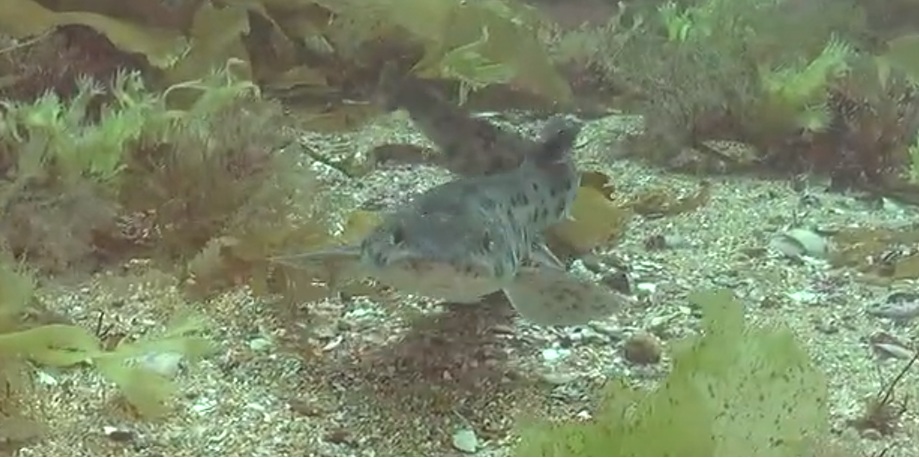
Two species of Catsharks are found in the Helford, the Bull Huss or Greater Spotted Catshark, and the Lesser Spotted Catshark, previously known as Dogfish.
The Bull Huss can reach a length of 1.6m, but both species are harmless and feed on molluscs, crabs and the occasional small fish. Females produce eggs, called mermaid purses, which hatch out after some 6-8 months. The nearby Fal Estuary is a nationally key nursery area for young Bull Huss.
A commonly seen flat cousin of theirs is the Thornback Ray. Their females also lay eggs which technically makes them Skates not Rays! Males can be readily be determined by a pair of claspers which are modified pelvic fins used in mating. There colour varies considerably so the best way to identify them from other rays is by the line of thorns along their back and tail which give them their common name. When resting they tend to lightly bury themselves to improve their camouflage. They can quickly turn 180 degrees by swinging their tail around. Females use their pelvic fins to ‘walk’ along when there is no need to hurry but once they engage their pectoral fins or ‘wings’ they can swim very rapidly if necessary.
Chris Lewis
December 2025
Join our Helford River Cruises from Budock Vean Hotel on the Helford and bring a snorkel along you never know what you might see!